In 2026, Call of Duty: Mobile is no longer an upcoming release. It is a long-running free-to-play first-person shooter that helped redefine what mobile players expect from a console-style multiplayer experience. Yet the original announcement from Activision and Tencent remains a useful snapshot of its ambition. The game was set to arrive on the App Store and Google Play on October 1, promising a feature-rich package brimming with content. That package included a 100-player Battle Royale mode alongside the usual Team Deathmatch, Search & Destroy, and Gun Game. It also drew on experiences from both the Modern Warfare and Black Ops series, which meant plenty of fan-favourite maps, killstreaks, and weapons.
What made that pitch so compelling? For one, it was not a stripped-down spin-off. It was positioned as a full Call of Duty experience on phones, with modes that could satisfy competitive players and casual fans alike. The inclusion of Modern Warfare and Black Ops content gave the game a best-of-both-worlds appeal, while the 100-player Battle Royale mode offered scale that mobile shooters had rarely attempted at the time.
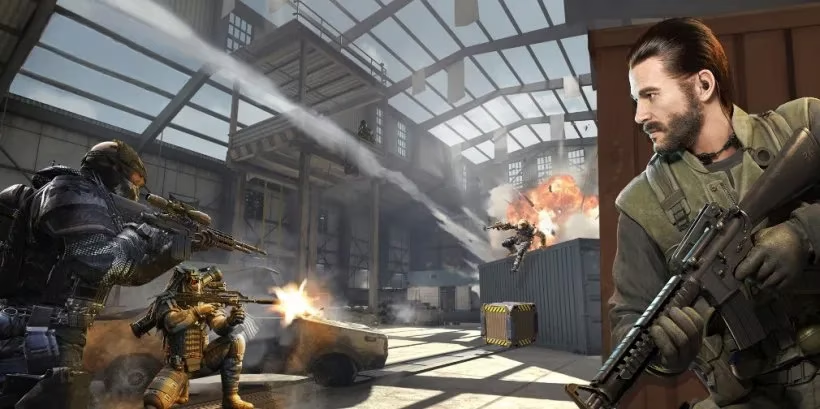
For nostalgic fans, the unlockable characters were a major draw. The roster included John “Soap” MacTavish, Simon “Ghost” Riley, and Alec “Remember the Numbers” Mason. These are not random skins; they are figures with history in the Call of Duty community. The game used the Operator system familiar from more recent COD titles. Operators are unique soldiers with special skills and scorestreaks, which added another layer of identity and strategy to multiplayer matches. In 2026, that operator-based structure feels standard for the series, but at the time it was a clear signal that Call of Duty: Mobile intended to mirror the mainline games rather than simplify them.
The Battle Royale mode was described as a massive test of survival on a huge and unique open map. Much like Black Ops 4’s Battle Royale map, COD Mobile’s version was a hodgepodge of iconic locales from Call of Duty games of yore. That design choice gave the map a sense of history, turning every drop into a tour of familiar battlegrounds. Matches played out over land, sea, and air, with fun vehicles including a helicopter, ATV, and tactical raft. The result was a mode that encouraged experimentation: players could rush into firefights, rotate across water, or take to the skies. Could a mobile game really support that kind of freedom? The original announcement suggested yes, and the years since have proven that the formula could work.
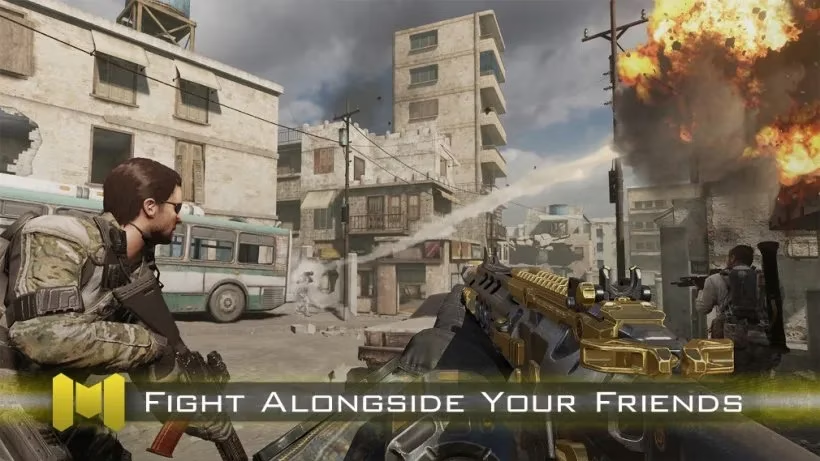
At launch, the game was set to be available in all countries except Belgium, mainland China, and Vietnam. The exclusion of Belgium was particularly telling. It suggested that loot boxes would make an appearance as part of COD Mobile’s free-to-play monetisation. Belgium had previously banned loot boxes after its gaming commission ruled that they represent an illegal form of online gambling. That decision put pressure on publishers to rethink how they sold random rewards. For players in territories where the game had already launched—Australia, Canada, and Peru—progress and unlocks were set to carry over, which was a welcome reassurance during the pre-release period. Pre-registration was also available on both the App Store and Google Play.
In 2026, those early details read like a time capsule. The mobile shooter market has grown crowded, and monetisation debates have only become more complex. Yet Call of Duty: Mobile’s core promise—console-style action, iconic characters, multiple modes, and a large-scale battle royale—still defines its identity. The game may have launched on October 1, but its legacy is measured in seasons, updates, and communities that continue to drop into the fight. For anyone who missed the original announcement, the message was simple: this was not a side project. It was Call of Duty, built for mobile, and it was coming to nearly everywhere.
| Mode | What it offered |
|---|---|
| Battle Royale | A 100-player survival test on a huge open map with land, sea, and air vehicles |
| Team Deathmatch | Classic team-based combat |
| Search & Destroy | Round-based objective play |
| Gun Game | Progressive weapon challenges |
What does a launch plan from the past tell players in 2026? It shows how quickly mobile shooters matured. It also explains why Call of Duty: Mobile remains part of the conversation: it brought mainline characters, operators, scorestreaks, and battle royale scale to a device in nearly every pocket. The original October 1 release was only the beginning.