By early January of 2020, a faint but unmistakable signal had begun to pulse through the Call of Duty Mobile community. Season 3 was waiting just beyond the horizon, scheduled to arrive on January 22, and Garena had once again thrown open a narrow side door for the most eager operatives. For a young player named Aris, who had spent hundreds of hours inside the ranked trenches, the announcement felt less like a patch note and more like a distant lighthouse beam cutting across a black ocean.
A test server, as veteran players had learned by then, was not a simple demo. It was a sealed laboratory where unreleased weapons, maps, and balance adjustments were allowed to flex before being presented to the wider world. Garena had established a rhythm before every large update: first the test server, then the live release. Season 3 would not break that cadence.
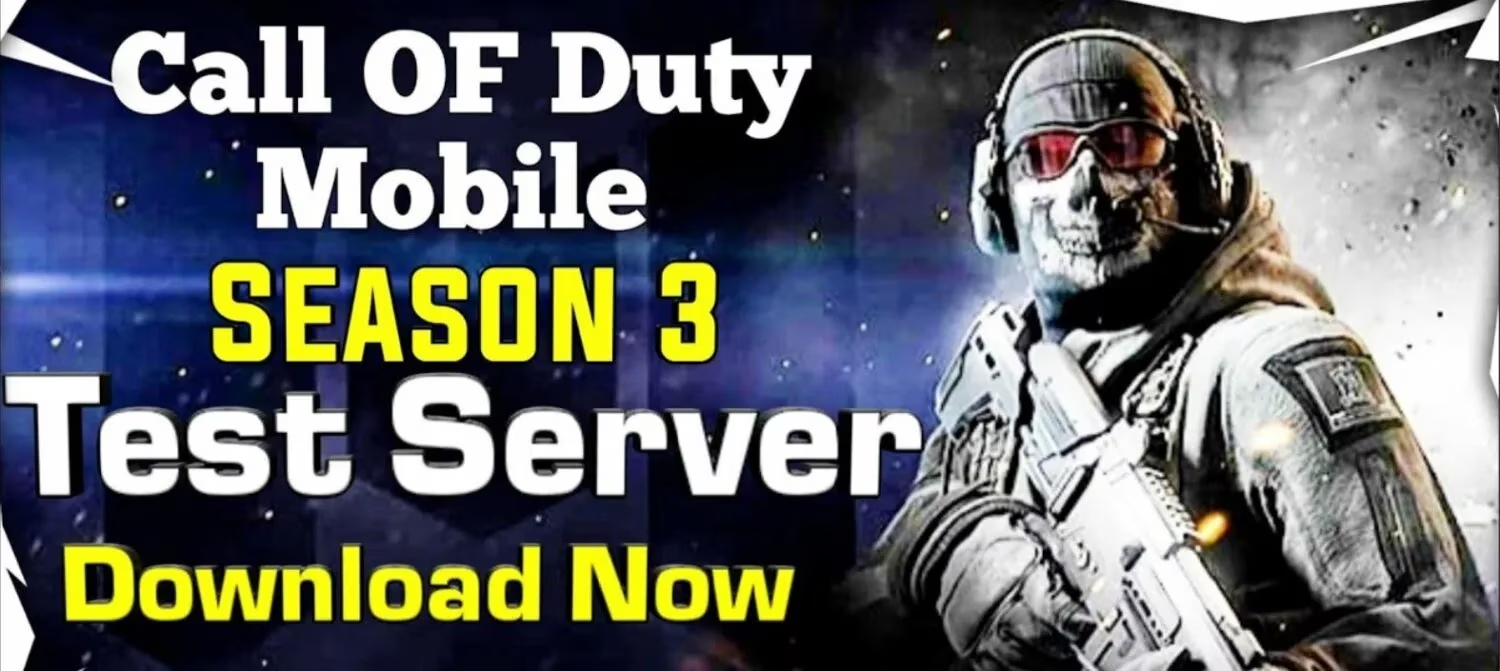
The first thing Aris noticed was that the server was not a borderless arena. Garena had confined access to the Southeast Asia region, leaving players elsewhere stuck behind an invisible turnstile. For those living inside that region, the process was as simple as stepping onto a familiar street. For everyone else, the path required a detour through a VPN, a kind of digital periscope that let a player surface in a Southeast Asian country without ever leaving their chair. The recommended tool among many players at the time was UFO VPN, though any reliable service pointed at Southeast Asia could work.
With the download file saved and the VPN ready, Aris began assembling his checklist. The process was not complicated, but it rewarded patience:
-
📦 Download the test server APK file.
-
🌐 Connect the VPN to a Southeast Asia region before doing anything else.
-
🎮 Launch the game only after the connection was stable.
-
⚠️ Never open the APK before the VPN tunnel was established.
That final warning was not decorative. Aris had heard stories from other players who treated the order as optional. They described the same result: the game would stutter for a moment and then fold inward, crashing like a kite caught in a sudden downdraft. Launching the test build before the regional gate had been unlocked was like trying to listen for a whisper through a wall of steel; the signal simply never reached the other side.
For Aris, the route worked. He connected to a Southeast Asian server, opened the APK, and watched as the test client bloomed onto his screen. The experience had the quality of a twilight reconnaissance mission, mixing half-familiar mechanics with unreleased maps and unannounced balance shifts. Every new corner felt like peering into a room before its doors had officially opened.
Beyond the test server, the road to a new season carried other quiet lessons. Ranking up in Call of Duty Mobile was not purely about reflexes or loadouts. Movement timing, map awareness, objective trade-offs, and squad communication all acted as hidden multipliers beneath the surface. Aris had learned to treat each ranked match as a postcard sent from a larger strategy; what seemed like a single engagement was often decided long before the first bullet cracked the air.
The community's excitement around Season 3 was not difficult to understand. A new season meant more than cosmetic surface changes. It brought weapon tuning, map rotations, potential battle pass content, and a fresh ladder to climb. Test servers gave players an early glimpse of that machinery, a chance to adapt before the official release rolled across the live servers.
Even viewed from the distance of 2026, the ritual still feels familiar. Call of Duty Mobile has moved through countless seasons since that January, evolving with new operators, weapons, and map redesigns. Yet the test server remains one of the clearest examples of how a limited beta can turn anticipation into preparation. For players like Aris, it was never just about seeing content first. It was about standing close enough to the future to feel its heat before the rest of the world arrived.